Richard Gene, the YouTuber who fishes as 'The Fishing Machine,' put a 16-inch white crappie in the bucket on the Tennessee River by going back to a deep-water bottom-bumping pattern he hadn't run in years - a method built around dragging weights along the bottom of 15 to 25 feet of open flats and letting the noise call fish up.
The trip opened almost immediately on a small offshore hump tucked between creek channels. Two boom-boom bites produced a chunky 10-inch keeper and a 16-inch slab inside a couple of minutes. Richard Gene tossed a marker buoy on the spot, dropped it into a sideways drift, and ended up with a feed of fish out of what he described as no man's land.
"That fish was actually in 15 ft of water. I'd been concentrating in 19 to - I mean, from 17 to about 21 feet of water without a bite. And so these fish may have come up a little bit shallower," he said.
His case for bottom-bumping over more popular live-scope and dock-shooting techniques is direct. "This is the way to catch the giants. They're out here in open water roaming around on absolutely nothing. You might say just deep flats," he said. "White crappie don't really have to have much cover at all."
The rig is intentionally simple. A barrel swivel sits at the top of an 8 lb braid main line, with one or two drop-loops formed using his own version of a uni knot to hold a 5-8 inch leader at right angles to the line. Hooks are size-six Gamakatsu Stilettos, baited with tuffy minnows that he says outlast and out-fish standard shiners. At the bottom of the rig is a tin or lead drop-shot weight, crimped on so it can pull free if it snags a stump.
"This is going to be clipping the bottom making noise, which is what attracts these fish in my opinion," he said. "That tick tick tick on the bottom causes you to catch these big fish. I know it does because I know for a fact that catfish are attracted by that sound. Bass are attracted by that sound. Crappie are the same way."
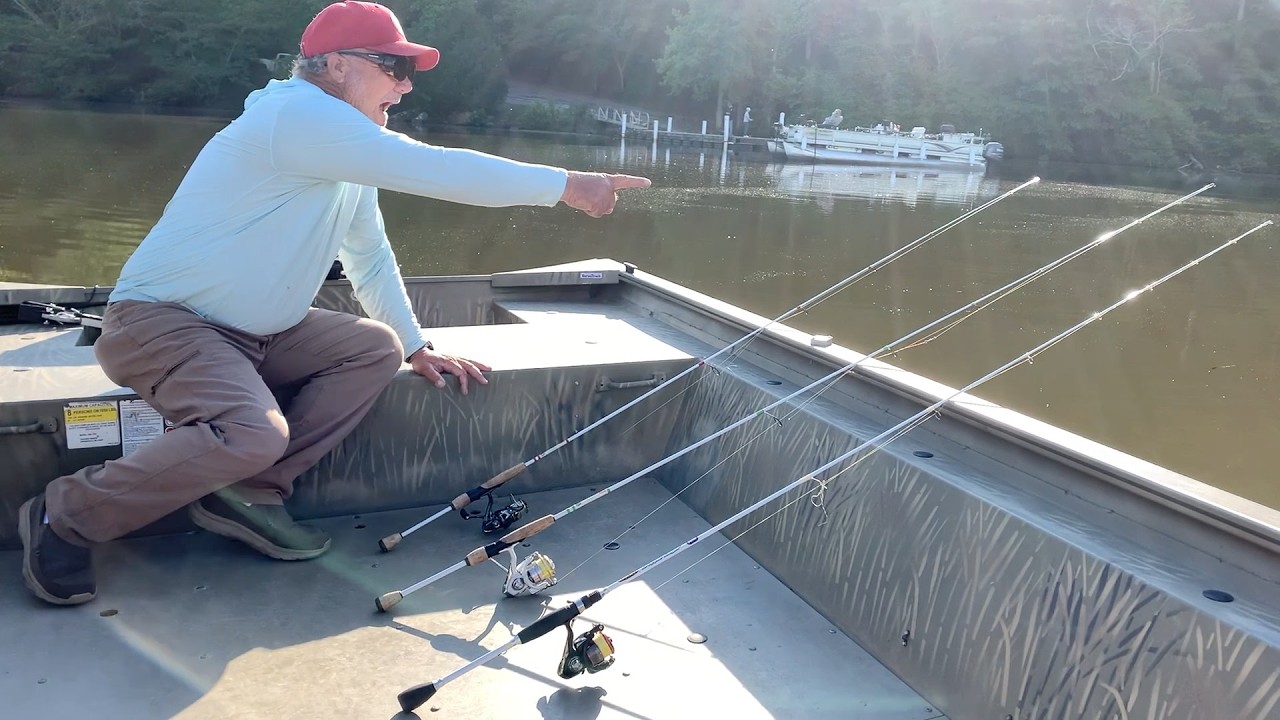
Boat control is the silent half of the technique. Richard Gene runs his kicker motor turned sideways into the wind to hold the boat broadside, fanning two or three rods over a wide arc as the rig drifts across the flat. He recommends a drift sock for anyone who hasn't dialled in the kicker trick yet, and acknowledges that 16-foot deep stretches were more productive than the deeper water on the day filmed.
The fish themselves did most of the talking. A second 14-inch white crappie came up on a hard wind drift, hooked itself on the drop, and pulled hard enough to bury the rod tip. He kept boating fish until the bucket of tuffies was running thin.
"These deep water fish, when the wind's blowing this hard and you're fishing this deep, they're a battle," he said. "The biggest crappie you'll ever catch normally will be the rogue fish."
He also noted the technique doesn't punch a hole in the calendar. The same rig will work in summer when most fishermen have given up on crappie and moved to bass. "These fish stay out there deep. And a lot of them are rogue fish."
For southern crappie anglers running into the post-spawn lull, Richard Gene's drift-and-tick approach is a workable counterweight to the live-scope obsession that has taken over much of the modern crappie scene. The fish are still out on the deep flats, and a tungsten or lead weight tapping the bottom is loud enough to do most of the searching for you.